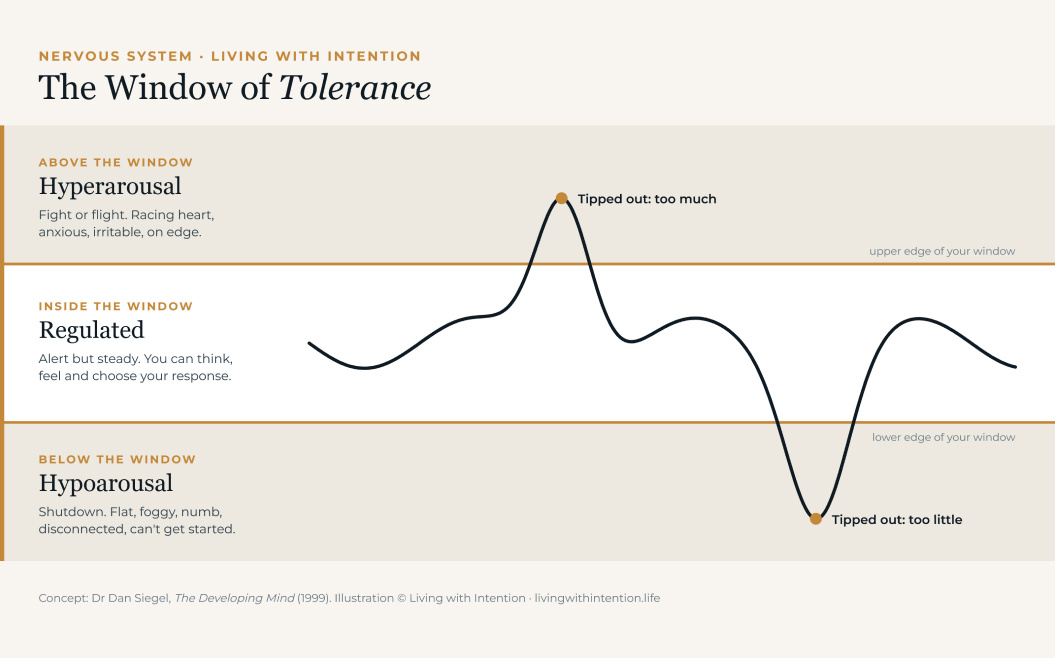
What is the window of tolerance?The window of tolerance is the zone where your nervous system can handle what's happening and you can still think, feel and choose how to respond. Above it is hyperarousal (fight or flight). Below it is hypoarousal (shutdown).
Who came up with the window of tolerance?Psychiatrist Dr Dan Siegel introduced the term in his 1999 book The Developing Mind. It has since become a standard idea in trauma therapy, stress work and coaching. The diagram on this page is our own illustration of his concept.
What is hypoarousal?Hypoarousal is what happens when you drop below your window. You feel flat, foggy, numb or disconnected, and getting started on anything feels impossible. In polyvagal terms it's the dorsal vagal shutdown state. It often gets mistaken for laziness. If it lasts for weeks, talk to your GP.
What is hyperarousal?Hyperarousal is what happens when you go above your window. Your heart races, your thoughts speed up, you feel on edge, irritable or panicky, and sleep gets hard. In polyvagal terms it's the sympathetic fight-or-flight state.
How do I widen my window of tolerance?Learn the early signs that you're tipping out. Come back inside before you try to solve anything. Practise regulation daily while you're calm, step towards stretching situations in small doses, and protect your sleep. The window widens over weeks and months, not overnight.
How does trauma affect the window of tolerance?Trauma can leave the window narrower, so you tip into hyperarousal or hypoarousal faster and with less warning. That's a nervous system that learned to protect you, not a personal failing. If you have a trauma history, work with a trauma-informed therapist alongside any self-practice.
Is the window of tolerance the same as polyvagal theory?No, but the two fit together. Siegel's window describes how much activation you can handle. Porges's polyvagal theory describes the states your body moves through. Above the window lines up with the sympathetic state, inside it with ventral vagal, and below it with dorsal vagal.